Who's Redo'ing What and Why
Each piece runs on the same data as the calculators.
))
California · Solar
California solar under NEM 3.0: all we have to decide is what to do with the utility that is given to us
Los Angeles has the best solar payback of the six utilities here, 5.0 years on a 31.6 cent rate, because LADWP is exempt from NEM 3.0 and still pays full retail for exports. A battery pays for itself in 6.0 years at SDG&E, more slowly at SCE (7.8 years), and takes 8.7 years at PG&E, most of its ten-year warranty. It loses money in LADWP territory, where the grid is already a free, lossless battery. Find what your utility pays for an exported kilowatt-hour and what it charges at 7 PM, and subtract.
Restaurants · Solar and rates
Heat pumps and solar for restaurants, part 2: picking up the dinner bill
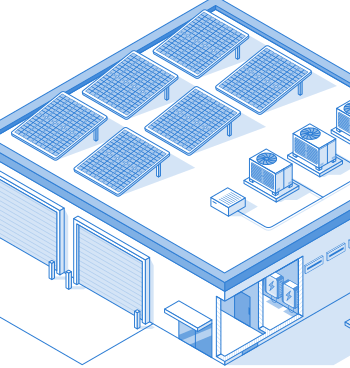
A restaurant's peak is dinner, after the sun goes down, and most time-of-use rates we track price that hour highest. Solar covers the daytime base. A battery sized to the demand peak covers about a third of dinner. On its own it pays back in three to five years at Southern California Edison and SDG&E, six to nine in Massachusetts (four or five with ConnectedSolutions), and six or longer in the Southeast, depending on the demand charge. On a restaurant's own roof, where it also stores the midday surplus, it usually pays back sooner. At Xcel Colorado, with no demand charge under 50 kW, it earns about $2,700 a year shifting dinner and pays back in about eight. On PG&E's small-business rate, with no demand charge, a battery alone doesn't pay back, but on a restaurant's own roof it pays back in four or five years. Where a ratchet applies, a heat pump sized without strips rides under the summer floor for free.

Restaurants · Heat pumps
Heat pumps for restaurants, part 1: start with the water heater
If your water heater is electric or propane, a heat pump water heater is the biggest single win in the building: $2,871 a year for a counter-service shop on National Grid in Massachusetts, eight years to pay back on its own, under three on Mass Save's small business offer, and it is the tenant's equipment. If it is gas, it is close, and your utility's rate and the air the unit breathes decide it: replace at end of life, mount the module where the kitchen air is warm and the grease isn't, and let a booster carry the rush.

Rates · Data centers
Data centers are coming for your utility bill. Here is the actual math, and the hedge.
PJM's capacity price rose eleven-fold in three years and is landing on retail bills across 13 states and DC. Gas is rising for the same reason, so neither fuel escapes; the question is which one your equipment turns into heat three times as efficiently. Weatherize first, electrify oil and propane without hesitation, and run gas against a heat pump with escalation on both sides.

Massachusetts · Heat pumps
Heating oil vs heat pump in Massachusetts: the 2026 math
Heating oil in Massachusetts delivers heat at about $45.70 per million BTU. A heat pump on Eversource's or National Grid's winter heating rate delivers it at $27 to $40. Over a typical 70 million BTU winter that is $410 to $1,280 a year before rebates, and 40 to 80 percent of it depends on one phone call: asking for the heating rate by name.
Minnesota · Heat pumps
In Minnesota, heat pumps lose to gas. But pipeline builders hate this one trick...
On the standard Xcel rate a heat pump loses to $1.07 pipeline gas by about 58 percent. On the dual-fuel rate, 5.9 cents with your furnace covering the few coldest mornings, it wins by about 45 percent and comes out roughly $540 a year ahead. Same house, same machine. Ask for the rate by name and have the installer set the changeover temperature from the math.